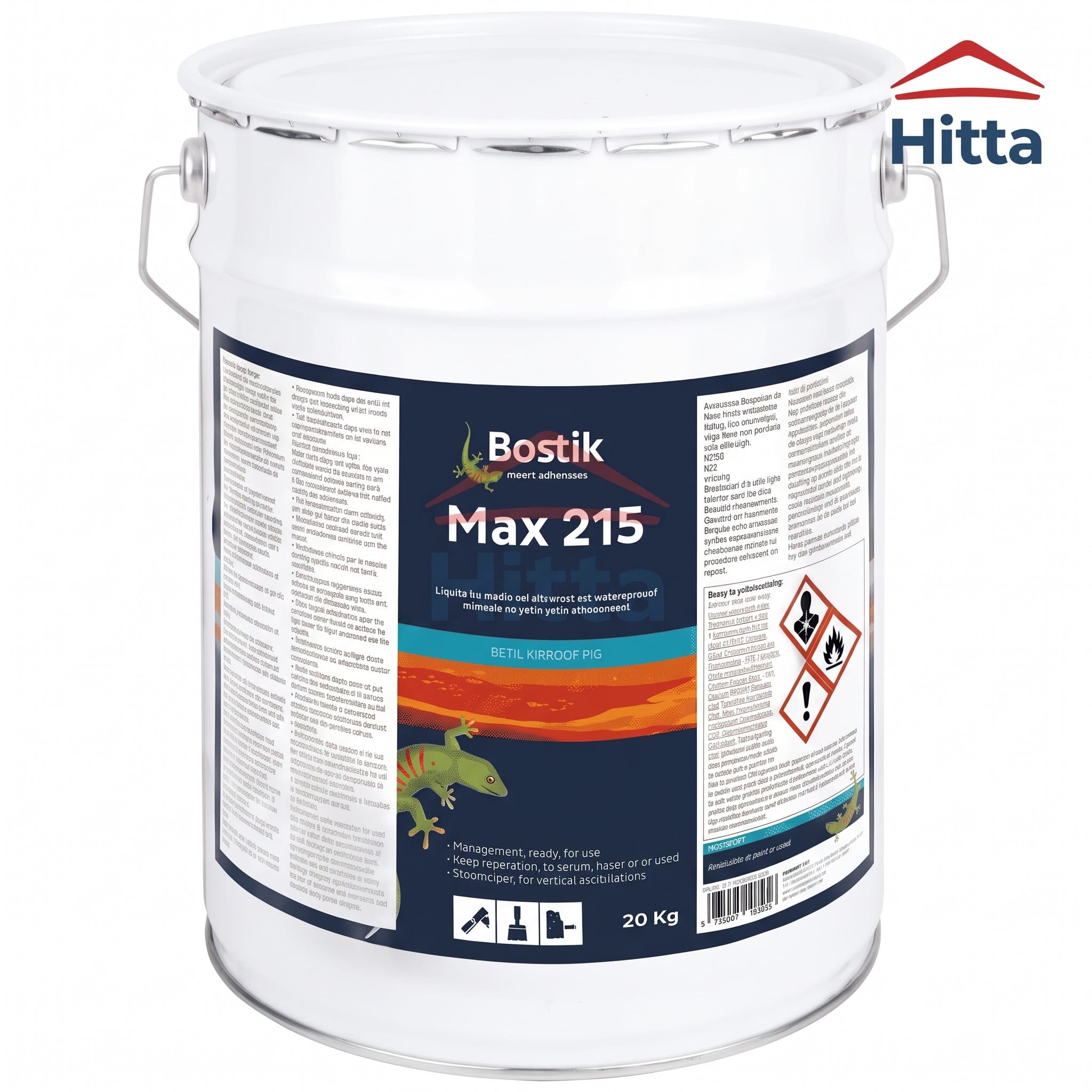
Bostik Max 215 Adhesive, bonding panel materials, aluminum sheets to composite panels
-
Elastic bonding and sealing between panels or between panels and frames, such as wood boards, fiber cement boards, Eternit panels, ALC panels, etc.
-
Used for sealing and bonding waterproof membranes made from various materials.
-
Suitable for bonding and sealing most construction materials, including metals, plastics, concrete, and more.
-
Ideal for metal structures, such as waterproof sealing of gaps between dissimilar materials in fume hoods, air conditioners, warehouses, containers, as well as elastic sealing of welds and joints.
-
Widely applied in signboard installation, glass display cases, interior decoration, and bonding or sealing of artistic works.
Bostik Max 215 Information
MAX215 is a premium elastic adhesive/sealant developed using Silyl Modified Polymer (SMP) technology. It offers excellent adhesion, weather resistance, and long-term durability.
Once cured, MAX215 forms a stable rubber elastomer with exceptional bonding performance on various substrates.
Features
-
Strong adhesion to most common substrates without primer.
-
Excellent UV and aging resistance.
-
High modulus, great elasticity recovery, and low shrinkage after curing.
-
Maintains flexibility over a wide temperature range (-40°C to +90°C).
-
Neutral, odorless, and fast-curing formulation.
-
Ultra-low VOC, eco-friendly, and free from formaldehyde, benzene, toluene, xylene, solvents, or isocyanates.
-
Non-staining and non-corrosive to substrates.
-
Paintable and compatible with many paint and coating systems (pre-testing recommended due to system variations).
Adhesion
Under normal conditions, MAX215 provides excellent adhesion to clean, dry, and grease-free surfaces — even without primer.
Typical substrates include:
aluminum, stainless steel, galvanized steel, zinc, copper, coated metals, glass, PVC, fiber-reinforced plastics, painted wood, etc.
However, it does not adhere to untreated polyethylene or Teflon.
For bonding different materials, especially rubber, plastics, or coated surfaces, pre-testing is advised to confirm compatibility.
For optimal results, contact our technical department for adhesion testing and recommendations.
Directions for Use
MAX215 can be easily extruded using a manual or pneumatic gun at temperatures between +5°C and 40°C.
In sealing applications, smooth and finish the bead before skin formation.
(Skin-over time varies depending on temperature and humidity. At 23°C / 50% RH, skin forms in approx. 20 minutes.)
Use a scraper or spatula for smoothing; tools may be moistened with soapy water, but avoid letting water seep between the sealant and substrate to prevent adhesion failure.
To remove uncured residue, wipe with a clean, colorless cloth moistened with isopropyl alcohol.
Storage
MAX215 can be stored for 12 months in its original, unopened packaging under cool, dry conditions between 5°C and 35°C.
Under normal circumstances, standard transportation methods will not affect product quality or performance.
Techdata
| tem | Specification |
|---|---|
| Basic material | Silyl Modified Polymer (SMP) |
| Curing method | Moisture |
| Tack free time | 10–30 min |
| Solvent content | 0% |
| Isocyanate content | 0% |
| Colors | Black, White, Grey |
| Density (23°C) | approx. 1.58 g/mL (GB/T 13477.2) |
| Sagging | 0 mm (GB/T 13477.6) |
| Curing rate | 2–3 mm / 24 hours |
| Shore A hardness | approx. 45 (DIN 53505) |
| Application temperature | +5°C to +40°C |
| Temperature resistance | -40°C to +90°C |
| Tensile strength | ≥ 1.5 MPa (GB/T 528) |
| Elongation at break | 300% (GB/T 528) |
| Volume shrinkage | < 3% (DIN 52451) |
| UV & weather resistance | Excellent |