
Fire-rated doors are specialized doors designed to withstand fire and smoke for a specified period of time, helping to compartmentalize building areas and ensure safe evacuation. These doors are typically constructed from multiple layers of fire-resistant materials—such as steel sheets, wood cores, gypsum boards, or vermiculite—and may even incorporate steel mesh or fire-resistant glass.
Adhesives play a critical role in bonding these diverse materials into a solid door structure that complies with stringent fire safety standards. In this in-depth article, we will explore how fire-rated doors are constructed, the legal and regulatory requirements they must meet, and why advanced adhesive solutions—such as modern polyurethane systems like “XPU”—have become the optimal choice for manufacturers of both wooden and metal fire-rated doors.
In addition, this article highlights the advantages of adhesives over traditional mechanical fastening methods, as well as the key factors manufacturers need to consider when selecting and applying adhesives in the production of fire-rated doors.
Solution Summary
Fire-rated doors are life-safety products that must reliably block fire and smoke. Achieving this level of performance requires precise engineering in both material selection and the bonding interfaces between layers.
In modern fire-door manufacturing, adhesives are indispensable—from composite wooden doors with MgO cores to premium steel doors with mineral wool cores. They provide strength, stability, and structural integrity under both everyday use and extreme fire conditions.
With high-performance adhesives (such as one- and two-component polyurethane systems), manufacturers can produce multi-layer doors that act as a unified barrier against fire.
Benefits of Choosing the Right Adhesive
- Strong and durable bonding between different fire-resistant materials
- Compliance with fire-rating standards by maintaining integrity at high temperatures
- Enhanced stability, tightness, and resistance to fire/smoke penetration
- Optimized production process with faster throughput and reduced cost
Key Evaluation Criteria for Manufacturers
- Heat resistance of the adhesive
- Adhesion to each substrate material
- Compatibility with existing production processes
- Proven compliance with certified fire-door designs
When done correctly, manufacturers can deliver fire-rated doors that are certified, durable, and life-saving, while also achieving their cost and productivity targets.
Providing adhesive solutions for fire-rated doors is not merely about supplying a product — it is about enabling customers to create doors that save lives, capable of withstanding both regulatory standards and the harshest trials of fire.
Construction of Fire-Rated Doors: Layers and Materials
Fire-rated doors are generally classified into two main types based on their construction: fire-rated composite wooden doors and fire-rated metal (steel) doors. In both cases, multiple layers of materials are bonded together, each serving a specific role in fire resistance or structural reinforcement. Adhesives are used to integrate these layers into a unified fire-rated door structure.
Fire-Rated Wooden Doors
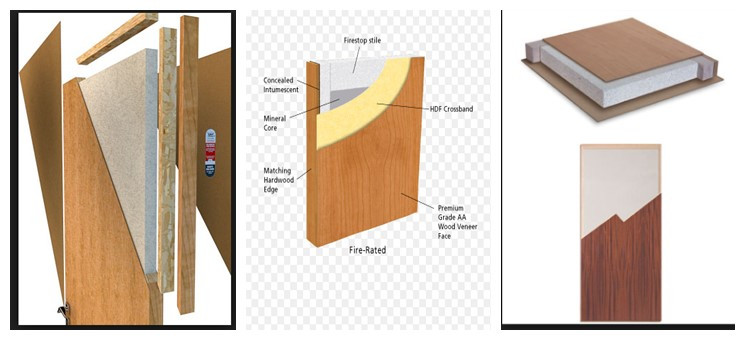
Fire-rated wooden doors are typically built as composite sandwich structures. A common configuration includes three main bonded layers:
- Decorative Surface Layer (Veneer or Laminate): The outermost layer is usually a thin wood veneer or laminate, providing an aesthetic finish suitable for interior design. Beneath the veneer, an engineered wood board (MDF or HDF) is often used for dimensional stability and as a base for the decorative surface.
- Structural Wood Core (Timber or Fiberboard): Beneath the surface lies a core of natural wood or engineered wood (such as blockboard, particleboard, or MDF). This core provides rigidity and mechanical strength. In higher fire-resistance designs, a specialized fire-resistant core is added (see next section).
- Fire-Resistant Core: To achieve fire performance, fire-rated wooden doors typically incorporate non-combustible boards inside the structure. Common materials include mineral boards such as calcium silicate or magnesium oxide (MgO), which offer superior fire resistance. In some designs, compressed gypsum boards are used, placed either throughout the core or in segments within the wood frame. These cores insulate and block flame penetration, typically surrounded by wood frames or bonded to outer wood layers.
These layers are bonded with high-strength adhesives, ensuring that the veneer adheres firmly to MDF, and the MDF to the fire-resistant MgO board, forming a stable three-layer structure. For example: a veneer is pressed onto MDF, then an MgO board is bonded to the other side, resulting in a veneer/MDF/MgO assembly. In this configuration, wood provides stiffness, MgO supplies fire resistance, and adhesives keep the entire system integrated under heat.
While decorative veneers must also meet flame-spread standards, the main fire performance comes from the internal core. Through lamination and adhesive bonding, manufacturers can integrate multiple materials without the need for screws or nails that could compromise fire barriers.
Fire-Rated Metal Doors (Steel Doors)
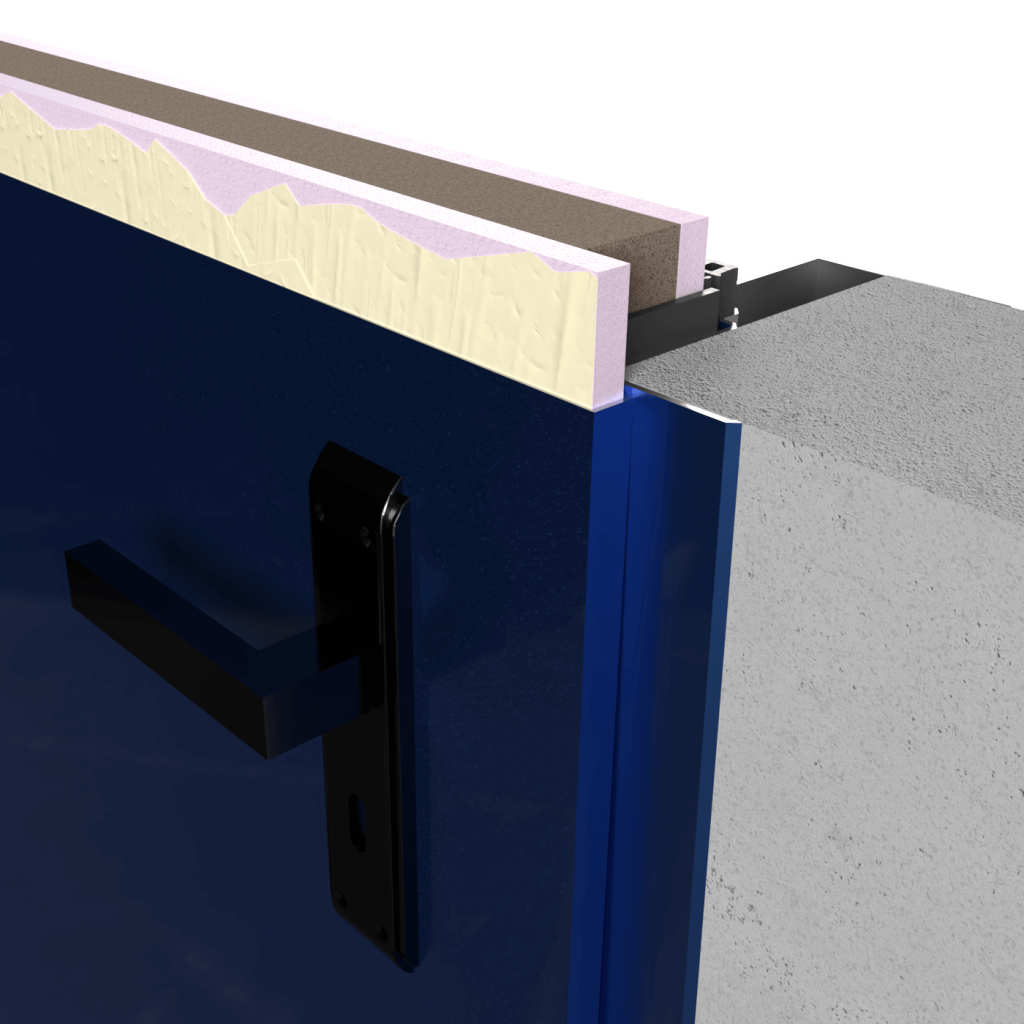
Fire-rated steel doors are typically manufactured as steel-based insulated sandwich panels, consisting of:
- Steel Face Sheets: Two outer steel sheets (typically 0.8–1.2 mm thick, galvanized or stainless steel) form the surface of the door. They provide mechanical strength, impact resistance, and serve as the first line of defense against flames. Although steel itself is non-combustible, it conducts heat; therefore, thickness and structural design are critical for maintaining integrity under fire. Steel faces may be coated with heat-resistant paint or intumescent coatings to prevent premature failure.
- Fire-Resistant Insulation Core: Sandwiched between the steel layers is an insulating core, chosen according to the fire rating required. The most common materials are mineral wool (rockwool), which is non-combustible with excellent thermal insulation, or high-density fire-resistant foams (such as fire-retardant polyurethane). Some designs may use honeycomb paper cores or mineral boards (perlite, gypsum) to combine insulation with structural reinforcement. The core slows down heat transfer and protects the non-fire-exposed face. For higher fire ratings (90 minutes to 3 hours), non-combustible cores like rockwool or compressed gypsum are typically required. Lower-rated doors (20–45 minutes) may use honeycomb or specialized foams.
- Adhesive Bonding: The steel sheets are bonded to the core with structural adhesives rather than relying only on mechanical fasteners. This ensures full surface support, eliminates gaps, and maintains structural integrity if steel deforms under heat. Adhesives are particularly critical in fire-rated steel doors, enabling the core and steel to work together under thermal and mechanical stress. Polyurethane structural adhesives are widely used to bond steel with mineral wool or fire-resistant foams in premium doors.
Thanks to this sandwich design of steel and insulation, fire-rated metal doors achieve both mechanical durability and fire resistance: steel provides structural strength and fire shielding, while the insulating core prevents excessive heat transfer. Adhesives must withstand high temperatures to prevent delamination during a fire. In practice, the door’s performance depends on its “weakest link”—meaning steel, core, adhesive, seals, and hardware must all be tested as an integrated system.
Additional Components
Regardless of whether wooden or steel, fire-rated doors also require additional elements:
- Intumescent Seals: Usually installed in grooves around the door edges or frame. These strips (commonly graphite or sodium silicate) remain dormant under normal conditions but expand at high temperatures (~200°C), filling gaps between the door and frame to block smoke and flames. Some seals come with adhesive backing; if additional adhesive is used, it must not interfere with expansion.
- Fire-Rated Hardware and Frames: Door frames, hinges, locks, closers, and accessories must meet fire-resistance standards. Steel frames are often required for doors rated over 90 minutes. For details such as fire-rated vision panels or decorative trims, adhesives and sealants may be used, provided they are fire-resistant and do not compromise the certification of the complete door assembly.
Requirements and Standards for Fire-Rated Doors
The manufacturing of fire-rated doors is strictly regulated — these products must undergo rigorous testing and certification to ensure performance in real fire conditions. Building codes typically mandate the installation of fire-rated doors in specific locations (such as stairwell exits, corridors, apartment entrances, and technical rooms), and each door must carry a certified fire-resistance rating (e.g., 30, 60, 90 minutes, or up to 3 hours).
A fire-rated door must remain intact, prevent flame penetration, and limit heat transfer throughout its certified duration. Every component — from materials, frames, and seals to adhesives — must perform reliably under extreme conditions.
Below are the key requirements and standards that fire-rated door manufacturers (and the adhesives used within them) must meet:
Fire Resistance Duration
- Fire-rated doors are classified by their fire-resistance time (e.g., 20, 45, 60, 90, or 180 minutes).
- During certification, the door is placed in a furnace following the standard time–temperature curve and must not burn through or collapse during the rated period.
- The core must maintain structural integrity, and the surface must prevent flame penetration.
- Adhesives are critical: if the bonding layer fails (burns, melts, or delaminates too early), the door may separate and lose fire resistance. Adhesives for fire doors must withstand high heat and maintain bonding strength.
Traditionally, fire-resistant wood adhesives have been thermosetting resins (phenolic, urea-formaldehyde), which char rather than melt under heat. Today, advanced polyurethane adhesives can also be engineered to meet these demands by forming strong crosslinked networks after curing.
Structural Strength and Stability
- Some standards require additional post-fire tests, such as hose-stream tests (water jet under pressure) or impact resistance checks.
- Doors must remain integral without large cracks or gaps.
- Bond lines must withstand thermal stress and sudden temperature changes (such as water cooling during firefighting).
- High-quality adhesives ensure the entire door behaves as a single, solid structure rather than separating along adhesive lines.
Thermal Insulation Performance
- In critical areas (such as stairwell exit doors in high-rise buildings), surface temperature rise on the non-fire side must be limited.
- The door core (e.g., mineral wool) plays the main role in insulation, but adhesives also contribute.
- Poor adhesive coverage can create voids or thermal bridges, reducing insulation performance.
- A uniform adhesive layer ensures full contact between core and facings, minimizing heat transfer.
- Some international standards specify limits (e.g., surface temperature rise not exceeding 250°F / 121.1°C above ambient within 30 minutes).
Smoke and Gas Tightness
- Many fire-rated doors must also be certified for smoke control.
- Doors must minimize smoke leakage under realistic conditions.
- Adhesives help by sealing joints between layers and substrates.
- In some designs, adhesives are used to bond perimeter seals or smoke gaskets, improving tightness.
- Alongside intumescent seals (which expand around 200°C), flexible adhesives and sealants contribute to closing micro-gaps, enhancing smoke protection.
Compliance with Certification Standards
- Each market requires compliance with its own certification system (e.g., UL, EN/CE, or other recognized bodies).
- Testing is always performed on the complete door assembly, including adhesives.
- Once certified, manufacturers must continue to use the same adhesive tested. Substituting adhesives without re-testing can invalidate certification.
- Therefore, manufacturers must choose adhesives with proven fire-resistance credentials, or at minimum, adhesives that have been tested in full-scale fire door assemblies.
Benefits of Using Adhesives in Fire-Rated Door Manufacturing
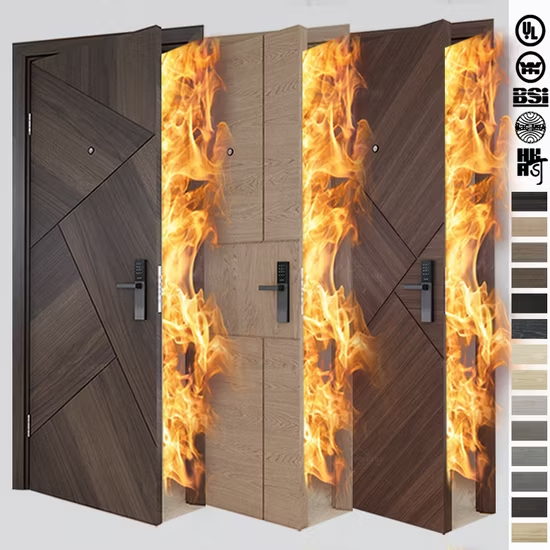
Today, the production of fire-rated doors relies primarily on adhesive bonding rather than mechanical fastening (nails, screws, rivets). The use of high-performance adhesives delivers several critical advantages:
Maintains Structural Integrity Under Fire
- Heat-resistant adhesives prevent door layers from delaminating, even under extreme temperatures.
- During fire tests, all layers must remain firmly bonded; premature separation leads to early failure.
- Thermosetting resins or specialized polyurethane adhesives typically char rather than melt, allowing the door to act as a single, unified barrier.
Even Stress Distribution – Reduced Warping
- Adhesives distribute stress uniformly across the entire surface, unlike screws or rivets that create localized stress points.
- Continuous bonding minimizes warping, cracks, or looseness over time.
- Example: bonding mineral fire-resistant cores to wood ensures panel flatness and tight sealing — both essential for fire performance.
Multi-Material Compatibility
- Fire-rated doors often combine diverse materials: steel with mineral wool, wood with MgO boards, glass with timber, etc.
- Polyurethane/XPU adhesives bond strongly to metals, foams, plastics, and porous mineral substrates — far beyond the capability of screws or rivets.
- This is why premium fire-rated steel doors use XPU polyurethane adhesives to bond steel with mineral wool or fire-resistant foams.
Superior to Mechanical Fastening – Aesthetics & Performance
- Flat surfaces with no visible screw/rivet heads; easier to finish with veneer or coatings.
- No drilling required → fewer weak points where heat, smoke, or flames could penetrate.
- No risk of fasteners loosening, corroding, or conducting heat during fire.
- Adhesive-bonded doors are lighter, since no extra reinforcement is needed for mechanical joints.
Enhanced Sealing – Better Fire & Smoke Protection
- Adhesives seal micro-gaps when bonding layers and edges, improving overall tightness.
- Seam sealing with fire-rated adhesives or sealants prevents hot gases and smoke leakage.
- Flexible fire-resistant sealants (e.g., silicone, MS polymer) add both elasticity and fire endurance, ideal for glazing, edging, or hardware joints.
Optimized Manufacturing – Faster & More Efficient
Industrial processes (roller coaters, vacuum presses, hot presses) enable mass production with adhesives.
PUR (polyurethane hot-melt) adhesives:
- Achieve fast initial strength within seconds or minutes → panels can be processed immediately.
- Boost production efficiency and lower assembly costs.
Adhesive assembly reduces reliance on screws/bolts, simplifying inventory and logistics.
Improved Overall Door Performance
- Better acoustics: bonded cores and facings reduce vibration and noise.
- Higher durability: resistant to delamination, moisture, and deformation.
- Longer service life: doors require less maintenance or replacement — critical, since changes can void fire certifications.
Polyurethane Adhesives in Fire-Rated Door Applications


High Mechanical Strength and Flexibility
- Moisture-curing PUR adhesives create elastic bonds while delivering outstanding mechanical strength.
- Capable of bonding wood, MDF, steel, composite panels, and mineral wool cores.
- The unique balance of strength and flexibility allows doors to maintain integrity under thermal expansion or mechanical stress.
- Excellent resistance to moisture and heat, making them suitable for diverse operating environments.
Fire Resistance and Protective Char Formation
Many PU adhesives for fire-rated doors are formulated with intumescent additives or char-forming resins.
Under fire exposure, these systems form a protective carbonized layer that:
- Slows down flame spread
- Seals joints against smoke leakage
Such PU adhesives can meet stringent fire standards (UL 10C, GB 12955, WDMA I.S.1A), ensuring the door maintains performance during fire exposure.
High Initial Strength – Optimized Production Efficiency
- Hot-melt PUR (HMPUR) delivers very high green strength, allowing panels to be handled, transported, or further processed immediately after pressing.
- Enables fast, continuous automated production, minimizing curing delays.
- Cures at relatively low temperatures → saving energy and accelerating assembly.
- Particularly effective for bonding steel facings to mineral cores, ensuring speed and production efficiency.
Durability and Weather Resistance
- PU adhesives for fire-rated doors are engineered to maintain performance over decades.
- Resistant to moisture, thermal cycling, and weather exposure → ensuring long-term reliability in varied climates.
- This durability is critical, as fire-rated doors must not only withstand fire incidents but also remain structurally sound throughout their service life.
Environmental Compliance
- Most modern PU adhesives are solvent-free and low-VOC, meeting stringent environmental standards.
- Compliant with indoor air quality requirements and green building certifications.
- Improves safety for end-users while reducing occupational risks for production workers.
Complying with Fire Door Standards
The performance of polyurethane (PU) adhesives in fire-rated doors has been validated through international standards and certifications. Their ability to maintain bonding strength, form protective char layers, and limit heat transfer enables fire-rated doors to meet or exceed global standards, ensuring not only certification but also maximum reliability under real fire conditions.
UL 10B/10C (North America)
- Many PU adhesives for fire-rated doors are tested according to UL 10C.
- Some products have achieved three-hour fire ratings under UL 10C, meaning doors assembled with these adhesives withstand positive-pressure furnace testing for up to 180 minutes.
- Specialized PU systems for steel doors and mineral-wool cores are also widely used and certified under these standards.
EN 1634-1 (Europe)
In Europe, adhesives in fire-rated doors must enable the door to achieve EI or EW classifications according to EN 1634-1:
E (Integrity): door prevents flame penetration
W (Radiation): limits heat radiation
I (Insulation): controls temperature rise on the non-fire side
Doors may be rated EI₁ or EI₂, depending on average and localized temperature-rise criteria.
PU adhesives are crucial in maintaining structural integrity, preventing bond-line gaps, and ensuring doors remain compliant throughout the test duration.
Other Standards
- GB 12955 (China): National standard for fire-rated doors.
- WDMA I.S.1A (USA): Standard from the Window & Door Manufacturers Association.
- Low-VOC, formaldehyde-free requirements: Align with modern green building standards and sustainable construction trends.
Contact Information
Hitta supplies a wide range of adhesive and tape solutions from leading global brands. Backed by an experienced technical team, we provide not only high-quality products but also tailored process optimization solutions to meet specific customer needs and challenges.
If you are looking for an efficient, durable, and reliable bonding solution, Hitta is your trusted partner — from consultation to implementation.
☎️ Hotline: 0565.336.879
✉️ Email: hittajsc@hitta.vn





