Solution Overview
Smart anti-glare rearview mirrors are complex assemblies that integrate multiple material layers and highly sensitive electronic components, including:
- Electrochromic Layers: The core element enabling anti-glare functionality, capable of changing transparency or darkness in response to an applied voltage. These layers are typically liquid- or gel-based and are highly susceptible to degradation if not properly sealed.
- Transparent Conductive Coatings: Essential for evenly distributing electrical voltage across the electrochromic layers.
- Sensors: Light sensors detect ambient light intensity and glare levels to activate the dimming function.
- Control Circuitry and Connections: Precision electronic components responsible for controlling the dimming process and communicating with the vehicle’s electronic systems.
During operation, rearview mirrors are exposed to a highly demanding automotive environment:
- Wide Temperature Fluctuations: From freezing winters to hot summers, repeated thermal expansion and contraction generate material stress.
- Humidity and Moisture: Moisture ingress can lead to short circuits and degradation of electrochromic materials.
- Vibration and Mechanical Shock: Continuous road vibrations and physical impacts can compromise delicate electrical connections.
- UV Radiation: Prolonged exposure to direct sunlight accelerates material aging if protection is insufficient.
Traditional encapsulation methods are often slow, lack precision, and struggle to simultaneously ensure long-term durability and optical performance.
Advantages of UV Adhesive Solutions
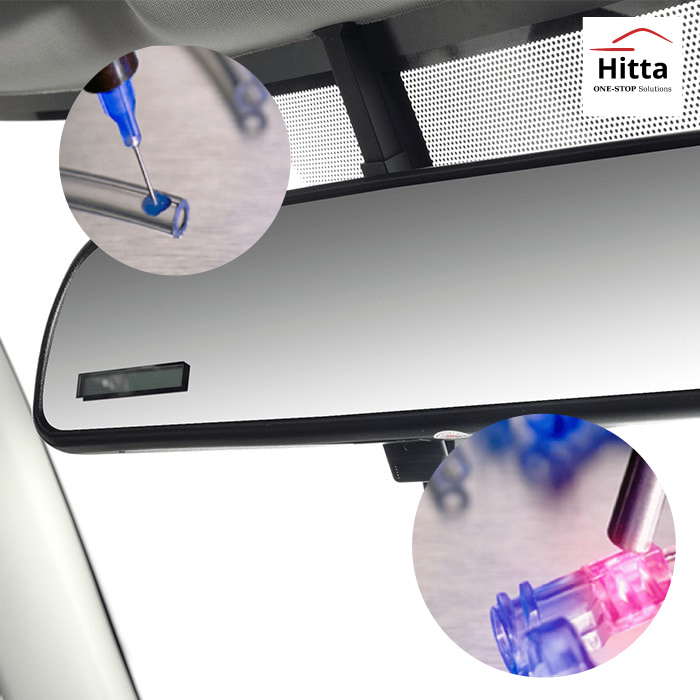
UV-curable adhesives provide a superior encapsulation solution for smart anti-glare rearview mirrors by combining speed, precision, and durability—capabilities that conventional methods rarely achieve at the same time:
- Instant Curing for High-Volume Production: UV adhesives cure within seconds upon UV exposure. This “cure-on-demand” mechanism significantly increases throughput and optimizes mass-production lines.
- Precise Application and Alignment: Remaining liquid until UV activation allows accurate positioning of electrochromic layers and conductive coatings prior to final fixation, ensuring optimal optical performance.
- Superior Sealing Performance: After curing, UV adhesives form a hermetic seal that protects sensitive components from moisture, dust, and chemicals, preventing material degradation and electronic corrosion.
- High Optical Clarity: UV adhesives can achieve excellent transparency, minimizing light scattering and yellowing over time, ensuring stable image quality and consistent anti-glare performance.
- Stress and Vibration Absorption: Certain UV formulations retain flexibility after curing, enabling effective absorption of vibration and compensation for thermal expansion, thereby protecting internal structures.
- Enhanced Durability and Extended Service Life: The robust protective barrier significantly extends mirror lifespan while reducing failure rates and warranty costs.
- Solvent-Free and Environmentally Friendly: Many UV adhesive systems are 100% solid, emitting no volatile solvents, contributing to safer manufacturing environments and reduced VOC emissions.
EverWide UV Adhesives for Smart Anti-Glare Rearview Mirror Applications
The level of electronic integration in automobiles and motorcycles is evolving rapidly. Even rearview mirrors are being “smartened,” with capabilities such as Wi-Fi connectivity, integration with driving recorders, and even navigation functions. One of the most critical roles of a rearview mirror is to provide early awareness of conditions behind the vehicle, helping prevent accidents before they occur.
However, traditional mirrors are prone to glare caused by high-beam headlights from vehicles behind, which can significantly impair driving safety. Smart anti-glare technology effectively addresses this issue.
Everwide places strong emphasis on multifunctional structural bonding solutions, enabling rearview mirrors to deliver dual functionality—anti-glare performance combined with rear-condition display capabilities. Bonding of rearview mirror glass is one of the key application areas for these adhesive solutions.
Everwide Product Applications Include:
- Special-Formulation UV Adhesives: UV adhesives blended with proprietary powders provide resistance to liquid crystal contamination and enhanced waterproof performance. These products successfully pass accelerated aging tests and withstand internal pressure immersion for over 8 hours while maintaining full functionality.
- UV Adhesives for Glass Bonding: Designed for glass-to-glass bonding, these adhesives feature fast surface curing, high heat resistance, and remain non-brittle after aging. Acrylic epoxy UV adhesives offer excellent water resistance and long-term reliability.
Contact Information
Hitta is a trusted provider of advanced adhesive and tape assembly solutions from leading global brands.
With a highly experienced technical team across multiple industries, we not only supply products but also deliver tailored bonding solutions that optimize your existing processes and address your specific application challenges.
If you are looking for a high-performance, durable, and reliable adhesive solution, let HITTA be your partner — from consultation to implementation.
- ☎️ Hotline: 0565.336.879
- ✉️ Email: hittajsc@hitta.vn
The Evolution of Smart Anti-Glare Rearview Mirrors

Modern automotive rearview mirrors are the result of a multidisciplinary engineering challenge, where sensitive microelectronic and optical systems must operate reliably within the harsh operating environment of a vehicle. The strategic transition from simple reflective glass to intelligent electro-optical hubs—integrating displays, sensors, and cameras—has introduced inherent conflicts between high-precision components and mechanical stress, thermal shock, and prolonged environmental exposure.
The integration of Advanced Driver Assistance Systems (ADAS), such as collision warnings and lane-keeping assistance, requires rearview mirrors to support embedded cameras and display modules.
At the same time, comfort features such as automatic anti-glare and mirror heating are rapidly becoming standard equipment—not only in premium vehicles but increasingly across mid-range segments. The continued advancement of autonomous driving technologies further accelerates this trend, as these systems rely heavily on highly accurate in-cabin and exterior visual sensing solutions.
This convergence has positioned materials science—particularly adhesive bonding technologies—as a critical enabler in preventing catastrophic failures of high-value systems, while ensuring long-term reliability throughout the product lifecycle.
Basic Structure of Smart Anti-Glare Rearview Mirrors
A smart or next-generation rearview mirror integrates multiple advanced technologies. These core functionalities have transformed mirror assembly far beyond a simple mechanical component, into a sophisticated electro-optical system:
- Automatic Anti-Glare (Electrochromic Technology): Utilizing stable and durable electrochromic gel layers that automatically darken when voltage is applied, reducing glare from headlights of vehicles behind. This foundational technology is widely adopted by leading manufacturers such as Gentex.
- Mirror Heating: Integrated heating elements rapidly eliminate fog, frost, snow, or condensation, ensuring clear visibility under adverse weather conditions.
- Blind Spot Warning: Embedded sensors and visual indicators alert the driver when another vehicle enters the blind spot—an essential active safety feature.
- Integration with Advanced Driver Assistance Systems (ADAS): Serving as a key interface for ADAS, smart rearview mirrors often incorporate cameras and display screens, delivering real-time information, parking assistance visuals, and alerts from systems such as adaptive cruise control.
Challenges in Bonding Smart Anti-Glare Rearview Mirrors
The multi-material nature and high-precision requirements of smart rearview mirrors make adhesive selection a mission-critical engineering decision—one that directly impacts long-term durability, functional performance, and manufacturing yield. Unlike conventional mirrors, smart mirror assemblies must bond dissimilar materials—glass, plastics, metals, and specialized functional coatings—while maintaining stable performance over many years under the harsh conditions of the automotive environment. An inappropriate adhesive choice can lead to premature failure, compromising both system safety and functionality.
Managing Coefficient of Thermal Expansion (CTE) Mismatch
One of the most significant challenges in any multi-material structure is the mismatch in the Coefficient of Thermal Expansion (CTE). As documented in studies by Patsnap Eureka, different materials expand and contract at varying rates in response to temperature changes. Within a smart mirror assembly, the glass substrate, plastic housing, metallic reflective layers, and embedded electronic components each exhibit distinct CTE values.
Throughout vehicle operation and environmental exposure, the mirror assembly undergoes continuous thermal cycling. These fluctuations generate mechanical stresses at the bonded interfaces—referred to in a PMC study as Thermal Coupled Mechanical Load (TCML). This phenomenon is a primary source of internal stress and a leading cause of mechanical failure.
While CTE management is a familiar challenge in automotive design, electrochromic mirrors introduce far tighter constraints. The microscopic tolerances of the electrochromic cell and the strict requirement for a fully hermetic seal mean that even minimal thermally induced stresses pose a direct threat to core functionality and device lifespan.
The consequences of inadequate CTE mismatch control can be severe, including:
- Seal Failure: This is the most critical failure mode for electrochromic mirrors. Field failure analyses have identified “epoxy adhesive failure” as the direct root cause of mirror degradation in real-world use. This conclusion is further supported by patent literature (US7009751B2), which identifies loss of seal integrity as the primary failure mechanism in accelerated durability testing.
- Delamination: Separation between bonded layers disrupts the optical path and compromises structural integrity.
- Cracking and Fracture: Microcracks may develop in brittle materials such as glass or within the adhesive layer itself, potentially leading to catastrophic failure.
Ensuring Hermetic Sealing and Environmental Resistance
A durable, fully hermetic adhesive seal is the single most critical factor determining the long-term performance of electrochromic mirrors. This sealing layer is responsible for protecting sensitive internal components—including the electrochromic gel and delicate electronic circuitry—from environmental ingress.
The bonded joint must be engineered to withstand a wide range of environmental stressors throughout the vehicle’s service life, including:
- Solvents and Chemicals: Resistance to automotive cleaners, fuels, and other specialized vehicle fluids.
- Extreme Thermal Cycling: Retention of adhesion strength and elasticity across a wide temperature range, from freezing conditions to elevated temperatures caused by direct solar exposure.
- Ultraviolet (UV) Radiation: Resistance to material degradation from prolonged sunlight exposure, which can otherwise cause yellowing or embrittlement.
- Humidity and Moisture: Effective prevention of water ingress—one of the primary causes of electronic corrosion and electrochromic material degradation.
UV Adhesives for Smart Anti-Glare Rearview Mirror Applications
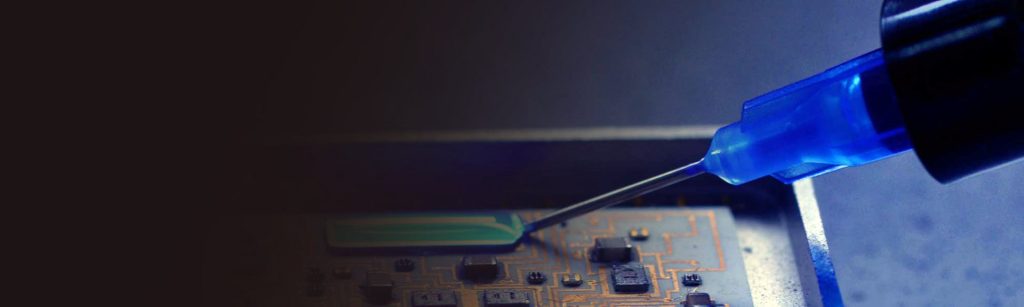
Ultraviolet (UV)-cured adhesives have emerged as a key enabling technology, particularly well suited to the stringent requirements of smart rearview mirror manufacturing. Thanks to their unique material properties and processing mechanisms, these adhesives provide an optimal solution for the high-precision bonding of optical and electronic components—playing a strategic role in meeting the automotive industry’s demands for high-volume, high-quality production.
UV Curing Mechanism
The core principle of UV adhesives lies in their cure-on-demand characteristic. The adhesive remains in a controllable, dispensable liquid state until it is exposed to a specific wavelength of ultraviolet (UV) light. Upon UV exposure, a rapid polymerization reaction is initiated, transforming the adhesive from a liquid into a solid, cross-linked polymer that forms a strong and stable bond.
This mechanism gives manufacturers precise control over both the timing and location of bonding, as curing only begins when activated by UV light—effectively preventing premature curing during assembly operations.
To accommodate complex three-dimensional assemblies and challenging geometries, dual-cure UV adhesive formulations have been developed. These systems incorporate a secondary curing mechanism—typically thermal curing—in addition to UV activation. This allows the adhesive to fully cure in shadowed areas where UV light cannot directly penetrate, ensuring uniform bonding strength and structural integrity throughout the entire assembly.
Documented Applications in Electrochromic Mirror Manufacturing
The use of UV-cured adhesives in electrochromic mirror assembly has been clearly documented in foundational patent literature, underscoring the critical role of this technology in ensuring both product integrity and functional performance.
Electrochromic Fill Port Sealing
According to patent US7009751B2, UV-cured adhesives are used to seal the fill port after the electrochromic medium has been injected, creating a durable and long-lasting hermetic seal.
Electrical Insulation Layer Formation
Patent US7826123B2 describes the use of UV-curable adhesives to form an insulating layer that prevents electrical short circuits between conductive coatings within the mirror structure.
The unique curing mechanism of UV adhesives, combined with their proven, real-world applications, delivers clear advantages in both manufacturing efficiency and long-term durability. As a result, UV-cured adhesives have become the preferred solution for the assembly of modern smart anti-glare rearview mirror systems.
Benefits of UV Adhesives
The adoption of ultraviolet (UV)-cured adhesives directly addresses the three core manufacturing metrics of the automotive industry: throughput (speed), yield (precision), and long-term reliability (durability). These advantages extend well beyond the physical bond itself, delivering process-level improvements across the entire production lifecycle and enabling reductions in both capital expenditure (CapEx) and operational expenditure (OpEx).
Enhanced Production Efficiency and Line Throughput
The most immediate and tangible benefit of UV adhesives is the significant reduction in manufacturing cycle time. Their rapid, on-demand curing mechanism stands in sharp contrast to conventional heat-cured or two-part epoxy systems, which may require several minutes—or even hours—to fully set.
With UV adhesives, curing occurs almost instantaneously, allowing subsequent assembly steps to proceed nearly immediately. This results in shorter overall production times and greater flexibility in line configuration and workflow management.
These process efficiencies translate directly into meaningful cost advantages, including:
- Reduced CapEx, by eliminating the need for large, dedicated curing ovens or thermal processing equipment.
- Lower OpEx, through decreased energy consumption and reduced long-term operational and maintenance costs.
Precision Assurance for High-Value Optical Components
In optical assemblies such as rearview mirrors—where even microscopic misalignment can degrade performance or introduce visual distortion—precise component alignment is non-negotiable.
The cure-on-demand characteristic of UV adhesives is a critical enabler of this precision. The adhesive remains in a liquid, workable state until UV exposure, giving assemblers sufficient time to accurately position and align components before the bond is permanently fixed.
This effectively eliminates the risk of component drift during slow or uncontrolled curing processes, ensuring that the tight tolerances required for advanced optical and electronic systems are consistently achieved.
Superior Bond Performance and Long-Term Durability
Beyond processing advantages, UV-cured adhesives deliver exceptional bond strength and environmental resistance, enabling the final product to withstand the harsh operating conditions of automotive environments throughout its service life.
- High Adhesion Strength: UV adhesives provide reliable adhesion to common mirror assembly materials, including glass, metals, and rigid engineering plastics.
- Optical Clarity: Once cured, the adhesive forms a strong yet optically transparent bond—critical for applications within the optical path—preventing image distortion or discoloration.
- Thermal and Environmental Stability: The cured bond exhibits excellent resistance to temperature fluctuations, humidity, chemicals, solvents, and UV radiation, helping to maintain hermetic sealing and protect the assembly from environmental degradation over time.
UV Adhesives vs. Other Bonding Technologies
In smart rearview mirror manufacturing, not all bonding technologies are designed to simultaneously meet the requirements for optical clarity, electronic protection, and high-precision mass production. The comparison below clearly distinguishes parameters that can be quantitatively evaluated from fundamental differences in bonding technology.
| Technical Criteria | UV-Cured Adhesives | Two-Part Epoxy Adhesives | High-Performance Adhesive Tapes |
|---|---|---|---|
| Application State | Liquid, precisely dispensable | Liquid, requires mixing | Solid |
| Curing Mechanism | UV light (cure-on-demand) | Chemical reaction | Pressure / time |
| Curing Time | Seconds – < 1 minute | Minutes to hours | Nearly instantaneous |
| Control of Cure Timing | Very high | Low | Not applicable |
| Alignment Precision | Very high | Moderate | Limited |
| Optical Clarity | Excellent | Moderate | Not suitable |
| Hermetic Sealing Capability | Excellent | Moderate | No |
| Suitability for High-Volume OEM Production | Excellent | Not suitable | Partially suitable |
| Automation Compatibility | Very high | Low | High |
| Typical Applications | Electrochromic cells, optical–electronic components | Aftermarket repair | Structural bonding, vibration damping (NVH) |
Two-part epoxy adhesive systems are widely and effectively used in aftermarket repair applications, where mechanical strength is the primary requirement and micron-level alignment control is not critical. However, within OEM manufacturing environments, their slow and poorly controllable curing mechanism makes them incompatible with the speed, repeatability, and precision demanded by electrochromic mirror assemblies.
In contrast, high-performance adhesive tapes excel in structural and mechanical applications, where gap-filling capability, vibration damping (NVH reduction), and fast installation are key priorities. That said, due to their inherently solid-state nature, adhesive tapes cannot flow to form a void-free, micro-scale, and fully hermetic seal—a mandatory requirement for protecting liquid electrochromic media and sensitive electronic components.
UV-cured adhesives are the only bonding technology that comprehensively fulfills all critical requirements of smart rearview mirror assembly: precise liquid dispensing, instant cure-on-demand, high optical clarity, true hermetic sealing, and full compatibility with high-speed automated production lines.
This unique combination positions UV adhesive technology as the enabling solution for next-generation smart anti-glare rearview mirror systems.