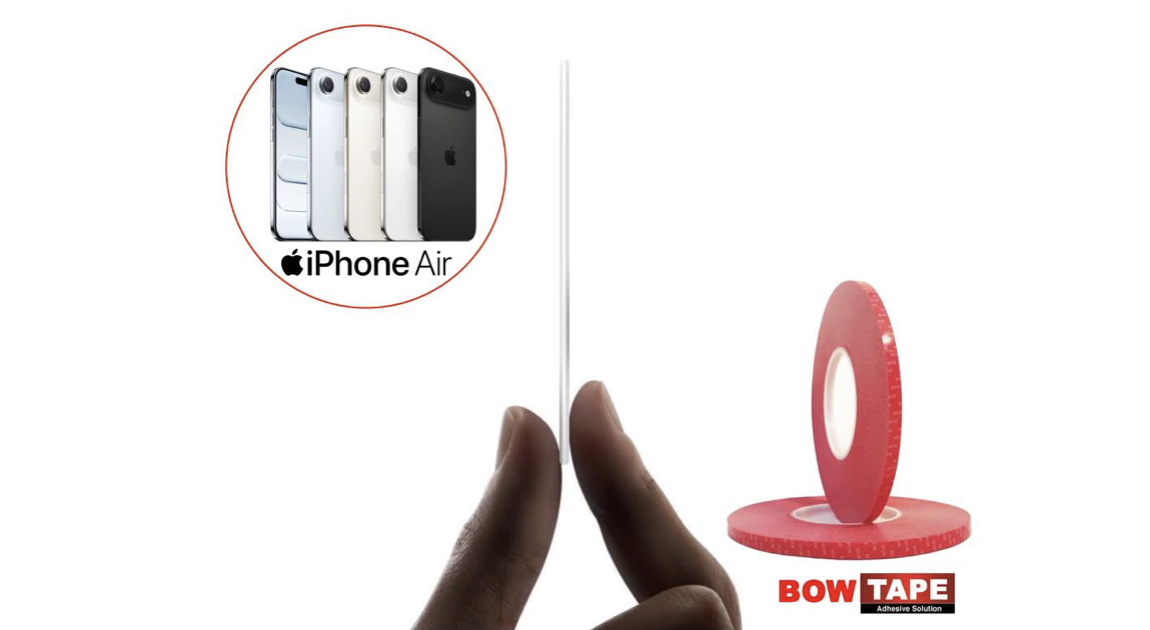
Ultra-thin adhesive tapes are specialized products engineered to provide strong, reliable bonding while maintaining maximum thinness. They typically range from just a few microns up to about 100 µm (0.10 mm) in thickness.
Despite their slim profile, these tapes deliver high adhesion strength, durability, and often excellent heat resistance. This makes them particularly suitable for applications where space and weight savings are critical. They commonly employ advanced pressure-sensitive adhesives (PSAs) such as acrylic or silicone, applied to an ultra-thin backing of polyester (PET), polyimide, or in some cases no backing at all (transfer tapes).
Ultra-thin tapes are available in both single-sided and double-sided forms, with specialized versions including optically clear and conductive grades for niche applications.
Technical Characteristics of Ultra-Thin Adhesive Tapes
Thickness and Form Factor
Ultra-thin adhesive tapes are defined by their extremely low thickness, typically ranging from 5 µm to 100 µm (0.005–0.10 mm). Most products fall within the 50–100 µm range. In extreme cases, they can be as thin as 10–30 µm while still providing effective bonding. These tapes are usually supplied in rolls (with release liners for double-sided types) and can be die-cut into custom shapes for precise assembly processes. A typical example: a 0.05 mm tape can create an almost “invisible” bond line between components.
Adhesive Types
Given their demanding performance requirements, ultra-thin tapes typically use pressure-sensitive adhesives (PSAs)such as acrylic or silicone, and occasionally synthetic rubber for specific needs:
- Acrylic adhesives are the most common, offering a good balance of adhesion, shear strength, and long-term stability. Many grades withstand 150–200 °C, with resistance to aging, UV, and chemicals.
- Silicone adhesives are chosen for extreme resistance to heat and chemicals, functioning continuously from –75 °C to 260 °C.
- Rubber-based adhesives deliver very high initial tack but lower heat resistance (about 80–100 °C).
All of these are pressure-sensitive, meaning they bond simply through applied pressure, even in very thin layers. Advanced formulations may also allow repositionability or clean removability, leaving no residue.
Carrier Materials
Ultra-thin tapes may include a carrier (backing) or be transfer tapes (adhesive only on a liner). Common carriers include:
- PET (polyester) films, typically 6–25 µm, for added strength and uniform thickness.
- Polyimide films (~25 µm) for high-temperature electronics applications.
- Thin paper/tissue (nonwoven) carriers used in some double-sided tapes for handling.
- Ultra-thin foams (~0.1 mm) to provide slight conformability.
- Thin metal foils (aluminum, copper, etc.) for EMI shielding or high-heat masking.
Transfer tapes (without a carrier) can be as thin as 50 µm or less, yet still bond strongly, even to low surface energy substrates.
Key Properties
Despite their slim profile, ultra-thin tapes deliver high performance:
- High peel and shear strength, comparable to thicker tapes.
- Outstanding heat resistance: many function at 150 °C, with some tolerating reflow soldering peaks up to ~280 °C.
- Excellent moisture and chemical resistance, particularly with acrylic and silicone formulations.
- Electrical properties: available in both insulating forms (e.g., polyimide tapes with dielectric strength ~6.5 kV) and conductive forms for EMI shielding or grounding.
- Optical clarity: certain grades are optically clear for bonding glass or films in touchscreens without distortion.
Product Formats
Ultra-thin tapes are available in rolls of various widths (from a few millimeters up to over 500 mm). Because of their delicate thickness, many double-sided versions include release liners (paper or PET) thicker than the tape itself. Some are double-linered to enable precise die-cutting. In industrial use, they are often supplied as pre-cut adhesive parts (e.g., smartphone display bonding pads, PCB dots). For DIY or household applications, they are packaged as small rolls with peel-away liners.
Automotive Assembly Applications
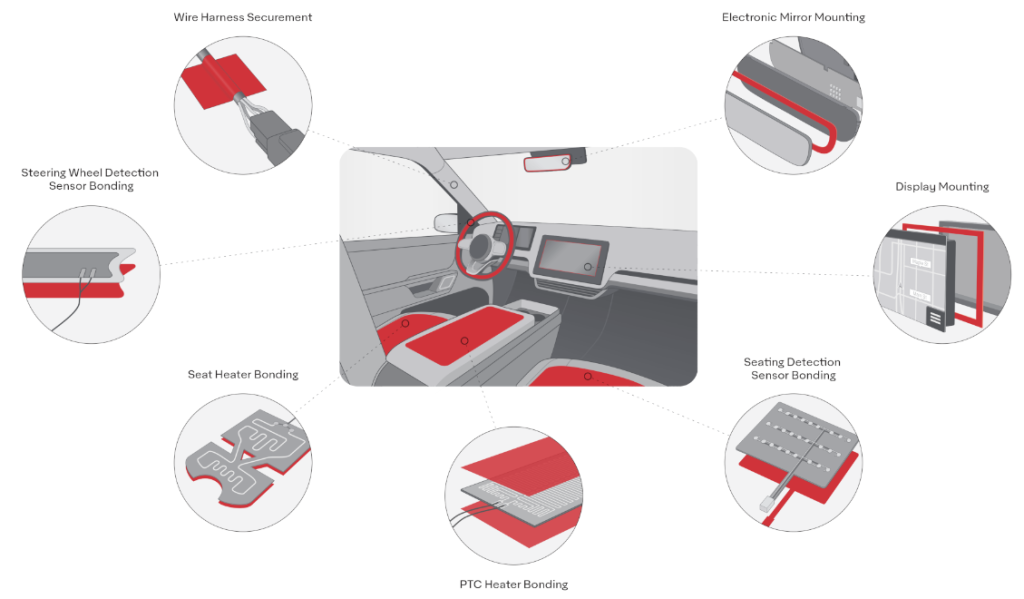
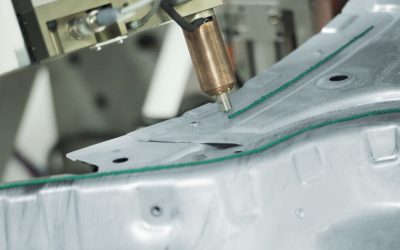
The automotive industry demands high-performance tapes for bonding and protection, and ultra-thin tapes are increasingly being used across different assembly processes.
Wire Harness Taping
Wiring looms in vehicles are typically wrapped with tape for bundling, insulation, and noise reduction. Traditionally, cloth or PVC tapes around 0.2–0.3 mm thick were common. Today, however, ultra-thin tapes (<0.1 mm) are available for tight spaces and high-heat areas.
- Some tapes as thin as 0.09 mm, using a polypropylene film with acrylic adhesive, fully meet stringent automotive requirements: –40 to +125 °C temperature range and compatibility with most insulation materials.
- Advantages: snug wrapping without bulk, plus better heat resistance than standard PVC tapes.
Interior Bonding and Trim Attachment
Ultra-thin double-sided tapes (~50–130 µm) are widely used to mount emblems, plastic trim, and interior panels.
- They provide an “invisible” bond line, keeping surfaces flush without gaps or raised edges.
- They maintain strong adhesion even under vibration and temperature cycling (–40 °C to over 85 °C).
- Often supplied in precision die-cut shapes for efficient application.
Noise Reduction and Anti-Squeak
Ultra-thin tapes are also applied to eliminate squeaks and rattles between plastic parts.
- Commonly used in dashboards, consoles, and doors.
- Thin felt tapes are also employed for cushioning and vibration damping.
Under-Hood and Engine Bay Applications
These areas involve harsh conditions of heat and oil exposure, where bolts or liquid adhesives were traditionally required. Ultra-thin specialty tapes (~50 µm) now provide:
- High tensile and shear strength, even at elevated temperatures.
- Short-term heat resistance up to 280 °C, suitable for soldering processes.
- Long-term durability at ~177 °C, with low outgassing and chemical resistance, ideal for electronic components in the engine bay.
- Typical uses include securing heat shields, sensors, batteries, or electronic modules.
Ultra-thin tapes under 0.1 mm not only replace traditional mechanical solutions in many automotive applications but also offer clear advantages in aesthetics, space savings, weight reduction, and component durability.
| Application Type | Thickness | Temperature Resistance | Adhesive Type | Typical Use Case |
|---|---|---|---|---|
| Wire harness tape | 0.09 mm | –40 to +125 °C | Acrylic PSA | Bundling automotive wire harnesses; halogen-free tape for engine areas, high flexibility |
| PE film tape | 0.08 mm | ~90 °C (est., suitable for automotive interiors) | Acrylic PSA | Noise reduction and anti-friction between interior panels |
| Ultra-thin transfer tape | 0.05 mm | –40 to +177 °C (280 °C short-term) | High-temperature acrylic | Bonding components in engine compartments (sensors, heat shields, etc.); chemical and heat resistance |
| Thin interior mounting tape | 0.21 mm(reference) | –40 to +150 °C (200 °C short-term) | Modified acrylic | Mounting emblems, decorative trim, and interior panels; strong double-sided tape for plastics/metal |
Note: Many automotive tapes are around 0.1–0.15 mm thick (e.g., PVC insulating tapes ~0.13 mm for wire splices, or acrylic foam tapes starting at ~0.15 mm). However, this table highlights ultra-thin solutions of ~0.1 mm or less, illustrating representative applications in the automotive sector.
Electronics Applications
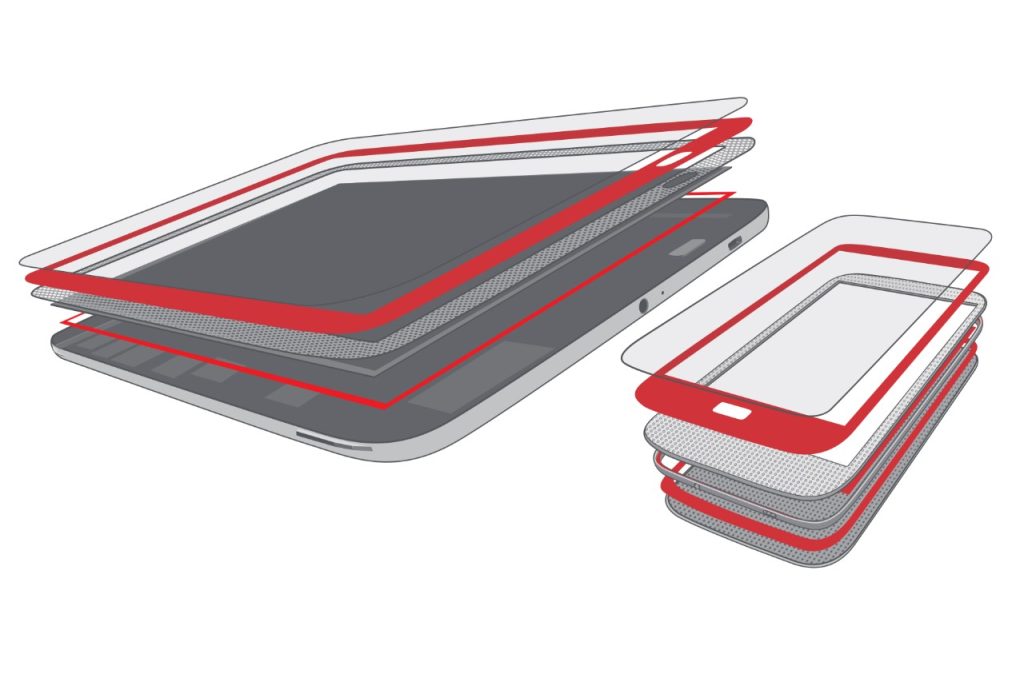
Electronics is the field where ultra-thin adhesive tapes demonstrate their full potential, enabling modern device assembly and component protection.
Smart Device Assembly
Compact devices such as smartphones and tablets rely heavily on ultra-thin double-sided tapes to secure components, replacing screws or bulky adhesives.
- Transparent tapes around 100 µm (0.10 mm) are commonly used to bond display modules, batteries, metal frames, and optical films.
- With short-term heat resistance up to 200 °C, they remain reliable during reflow soldering or in high-temperature device environments.
- The PET carrier layer provides dimensional stability and allows precise die-cutting for accurate assembly.
Flexible Circuits & Camera Modules
Some ultra-thin double-sided tapes are only 20 µm (0.02 mm) thick, making them almost indistinguishable from the electronic films they bond.
- Widely used in smartphone camera modules and LCD backlight films where space is extremely limited.
- Despite their thinness, they offer strong adhesion to plastics and electronic substrates, and comply with halogen-free standards.
- The ultra-thin PET carrier ensures uniform thickness and precise alignment during micro-assembly.
PCB Protection and Insulation
Polyimide (Kapton) tapes, typically 60–100 µm thick with silicone adhesive, are among the thinnest yet most heat-resistant electrical insulators:
- Continuous performance from –75 °C to 260 °C, and up to 400 °C short-term.
- Used for PCB masking, wave solder protection, and lithium battery cell insulation.
- With a dielectric strength of ~6.5 kV, they deliver outstanding insulation relative to their thickness.
- Common in power supplies, 3D printers, and heated beds, where ordinary tapes would fail.
Thermal Management
Ultra-thin thermally conductive tapes bond heatsinks, chips, or LEDs without the mess of thermal paste.
- Just 0.10 mm thick, filled with thermally conductive particles (~0.4 W/m·K).
- They provide both heat transfer and mechanical bonding (peel strength ~9.5 N/20 mm).
- Applications include mounting LEDs to housings, attaching thin heat spreaders to CPUs or ICs, keeping designs compact while maintaining thermal efficiency.
- Other thin thermal tapes (~0.125 mm) are also used to minimize thermal resistance at contact surfaces.
Optically Clear Adhesives (OCA)
OCA films are ultra-thin adhesive layers (~50 µm) used in touchscreens and displays:
- Bond glass to display panels without leaving air gaps.
- Improve optical clarity, reduce reflection, and prevent image distortion.
- Although they have no carrier film, they represent a key example of ultra-thin bonding solutions in electronics.
Thanks to these properties, ultra-thin adhesive tapes under 0.1 mm have become indispensable in the design and production of modern electronics, enabling products to be thinner, lighter, more durable, and higher performing.
| Product | Thickness | Temperature Resistance | Adhesive / Carrier | Typical Use Case |
|---|---|---|---|---|
| Ultra-thin PET double-sided tape | 0.10 mm (100 µm) | –40 to +100 °C (200 °C short-term) | Modified acrylic on PET film | Bonding smartphone components (LCD to frame, battery mounting) – high adhesion, heat resistant |
| Ultra-thin tape for micro-electronics | 0.02 mm (20 µm) | –20 to +85 °C (typical electronics range) | Acrylic on ultra-thin black PET (12 µm) | Micro-electronics assembly (camera modules, LCD optical films) – extremely thin bond for tight spaces |
| Polyimide insulating tape | 0.06–0.09 mm | –75 to +260 °C (400 °C short-term) | Silicone adhesive on polyimide film | PCB insulation & masking (wave soldering, coil insulation) – excellent heat resistance and dielectric strength |
| Ultra-thin thermal conductive tape | 0.10 mm | –40 to +120 °C (est., Tg ~125 °C) | Thermal acrylic, PET carrier | Attaching heatsinks or LED boards – simultaneous heat transfer and bonding, reduced thermal resistance |
| High-temperature transfer tape | 0.05 mm | –40 to +177 °C (280 °C short-term) | High-temp acrylic (no carrier) | Bonding FPCs, sensors on PCB – low-outgassing, ideal for high-temp electronics and automotive use |
Ultra-thin adhesive tapes represent a class of modern bonding and sealing solutions, delivering high performance in a form that is nearly imperceptible. From securing the sleek casings of smartphones, keeping automobile interiors free of squeaks and rattles, to enabling neat craft projects and quick household repairs, these tapes leverage the advantages of advanced materials—such as ultra-thin films and engineered acrylic or silicone adhesives—to tackle challenges that thicker tapes or traditional mechanical fasteners cannot.
As technology and design trends continue to move toward thinner, lighter products, the role of ultra-thin tapes across industries will only grow in importance. They allow both engineers and everyday users to “bond, secure, and protect” without compromising space or aesthetics—truly embodying the principle of “less is more.”
Contact information
Hitta is a trusted supplier of a wide range of adhesive and bonding tape solutions from leading global brands. Backed by a team of experienced technical experts with hands-on knowledge across various industries, we offer not only premium products but also tailored consultation to optimize your existing processes—ensuring they meet specific requirements and project challenges.
If you are looking for a high-performance, durable, and reliable bonding solution, let Hitta be your partner—from consultation through to implementation.
Contact us today to discover the most suitable adhesive solution for your application.
✉️ Email: hittajsc@hitta.vn
☎️ Hotline: 0565.336.879