
Solution Overview
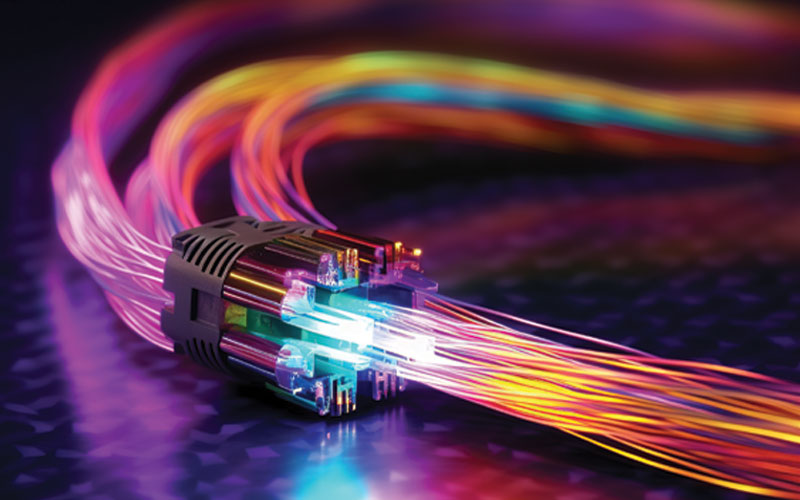
Products in the optical communications industry are highly diverse, with a broad range of applications including optoelectronic signal converters, optical receivers, fiber patch cords, signal amplifiers, bidirectional connectors, wavelength division multiplexing (WDM) systems, and more.
The primary focus is on adhesive reinforcement and bonding solutions for connection points within this industry.
Key product features include:
Low shrinkage that does not affect light transmission performance.
UV adhesives with crack-resistant properties, excellent optical clarity, and a refractive index designed to meet specific industry requirements.
Good handling characteristics that support efficient manufacturing processes and standard production requirements.
Outstanding high-temperature resistance, weather resistance, and long-term aging stability compared to conventional market alternatives.
Environmentally friendly epoxy systems with a 10:1 mixing ratio, low sensitivity, and skin-safe properties are available. Product types include UV-curable epoxy, one-component epoxy, and high-temperature-resistant two-component epoxy systems.
These products offer technical specifications comparable to leading international standards, with reliable packaging and stable, consistent quality performance.
Contact for Consultation
Hitta is a provider of a wide range of adhesive and assembly tape solutions from leading global manufacturers. With a technical team possessing extensive hands-on experience across multiple application fields, we do more than supply products—we provide expert consultation to optimize your existing processes and deliver solutions tailored to your specific requirements and technical challenges.
If you are looking for a bonding solution that is efficient, durable, and reliable, let HITTA support you from consultation through implementation.
Contact Hitta today to receive the most suitable solution for your application.
☎️ Hotline: +84 565 336 879
✉️ Email: hittajsc@hitta.vn
Why Are Adhesives for Optical Fiber Applications Different?
Bonding fiber optic components is fundamentally different from joining two conventional plastic parts. The bonding material must meet a stringent set of technical criteria to ensure that light transmission remains uncompromised.
First and foremost is optical transparency. The adhesive must be highly transparent, with excellent light transmission at the operating wavelength. Any haze, yellowing, or impurities may absorb or scatter light, leading to increased attenuation.
Refractive index matching is another critical requirement. To minimize Fresnel reflections at the interface between the fiber, ferrule, and adhesive layer, the adhesive’s refractive index typically needs to be compatible with that of silica fiber, approximately 1.45–1.50. Any mismatch can degrade signal quality and increase insertion loss.
Cure shrinkage is also an extremely important factor. Within micron-scale structures, even minimal shrinkage can induce stress, cause micro-bending, misalignment, or in severe cases, fiber breakage.
Additionally, once cured, the material must maintain dimensional stability and mechanical integrity over time, even under temperature fluctuations and humidity exposure. The adhesive must also provide sufficient mechanical strength to withstand tensile loads, vibration, shock, and thermal cycling.
For sensitive applications such as sealed optical modules, low outgassing characteristics are essential to prevent contamination of optical surfaces.
Finally, in high-volume manufacturing environments, fast yet controllable curing speed is a decisive factor in optimizing production throughput and process efficiency.
Common Types of Adhesives Used in Fiber Optic Applications

Traditional two-component epoxy adhesives have long been a common choice for bonding optical fibers into ferrules. They provide very strong mechanical bonding and excellent chemical resistance. However, their long curing time—ranging from several minutes to hours, and sometimes requiring elevated temperature—can slow production throughput. In addition, cure shrinkage may introduce risks in high-precision optical applications.
UV-curable adhesives represent a major advancement. These systems may be available in one-component or two-component formulations and cure within seconds when exposed to ultraviolet light. Their key advantages include extremely fast curing speed, on-demand curing capability, high optical clarity, low shrinkage, and reduced thermal stress. The main limitation is the requirement for direct UV exposure to initiate curing.
Acrylic adhesives offer fast curing and good adhesion to a wide range of materials. However, they may exhibit higher shrinkage or increased brittleness, which can be a concern in critical optical bonding applications.
Anaerobic adhesives cure in the absence of oxygen and are typically used to secure ferrules or metal housings. However, they are less commonly used for direct optical fiber bonding.
Hot melt adhesives enable rapid assembly and allow rework if needed. However, they require elevated processing temperatures, and their optical and thermal properties are generally inferior to epoxy or UV-curable systems for precision optical applications.
Typical advantages of UV adhesives for fiber optic applications include:
The most significant advantage is near-instant curing speed. UV adhesives polymerize within seconds under ultraviolet light, eliminating production bottlenecks and significantly increasing manufacturing throughput.
From an optical performance standpoint, UV adhesive formulations can be optimized to achieve high light transmission and precise refractive index control, minimizing signal loss at the bonded interface.
Extremely low shrinkage helps maintain precise fiber alignment, preventing micro-bending and fiber distortion—factors that are especially critical in fiber arrays and active alignment systems.
Beyond optical performance, UV adhesives also provide durable mechanical bonding capable of withstanding thermal cycling, humidity exposure, and harsh environmental conditions, from controlled data center environments to demanding outdoor installations.
The Role of UV Adhesives in Optical Network Infrastructure
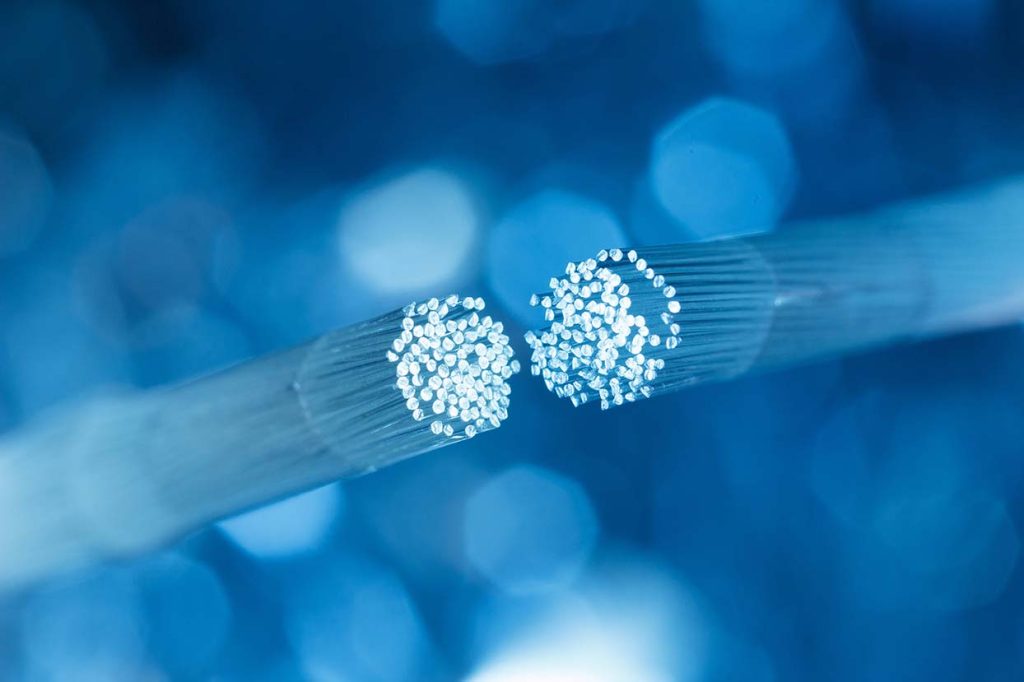
In the era of hyperscale data centers and widespread deployment of 400 Gb/s SR4.2 Ethernet, the strategic importance of UV-curable adhesives cannot be overstated. As transmission speeds increase, the link power budget has narrowed significantly—from more than 3.5 dB in traditional Gigabit systems to approximately 1.7 dB in modern 400G links. Within this limited 1.7 dB margin, a single Grade Cm connection—with an average insertion loss (IL) of approximately 0.5 dB—can consume nearly 30% of the total budget.
In high-density cross-connect systems that often involve four to six mated pairs, the tolerance margin is extremely tight. Any misalignment caused by adhesive shrinkage or fiber core movement can result in substantial signal loss. UV adhesive technology provides the precision and processing speed necessary to meet these stringent requirements.
The transition to UV adhesive systems is driven by several decisive advantages:
Ultra-fast processing speed: Surface curing can be achieved within seconds, significantly increasing throughput compared to traditional thermally cured two-component epoxies.
Sub-micron alignment precision: Immediate fixation of the fiber core within the ferrule eliminates fiber drift commonly associated with prolonged thermal curing processes.
Substrate protection: Enables bonding of temperature-sensitive polymers and thin-walled structures without introducing thermal deformation.
Extremely low VOC emissions: Most UV adhesives are solvent-free, improving environmental cleanliness and preventing optical contamination caused by outgassing.
These characteristics are directly linked to the photopolymerization efficiency and molecular structure of the photoinitiator system.
Photoinitiators and Initiation Mechanisms
The key factor determining monomer conversion rate and crosslink density is the type of photoinitiator used. These compounds must exhibit high molar absorptivity at the emission wavelength of the curing light source, typically within the 365–405 nm range for modern UV LED systems, ensuring rapid and complete curing throughout the adhesive depth.
The industry is currently undergoing a transition in photoinitiator selection. Phosphine oxide compounds such as TPO were previously considered standard; however, toxicological assessments conducted in 2019 by the European Chemicals Agency have accelerated the search for safer alternatives.
Germanium-based photoinitiators, particularly Ivocerin (bis(4-methoxybenzoyl)diethylgermane), have emerged as high-performance, non-toxic alternatives. These Type I photoinitiators offer fast initiation kinetics and absorption capability extending up to 480 nm, making them highly suitable for telecommunications and biomedical applications requiring high conversion efficiency and exceptional optical purity.
| Mechanism | Active Center | Formation Mechanism | Absorption Range | Chemical Examples |
|---|---|---|---|---|
| Free Radical (Type I) | Free radicals | Direct cleavage | 250–425 nm | Benzoyl derivatives, Ivocerin, TPO |
| Free Radical (Type II) | Free radicals | Hydrogen abstraction | 300–510 nm | Camphorquinone + amine |
| Cationic | Cations (Lewis acids) | Direct acid generation | 320–380 nm | Iodonium, Sulfonium salts |
In addition to light intensity and wavelength, ambient temperature also influences reaction kinetics, particularly in cationic epoxy systems, where curing continues after UV exposure in a process known as dark cure.
Comparison of UV Epoxy and UV Acrylate Systems
Selecting between cationic UV epoxy and free-radical UV acrylate systems is a critical engineering decision that directly impacts alignment accuracy, structural stability, and long-term optical reliability.
Cure Shrinkage and Alignment Stability
UV acrylates typically exhibit higher shrinkage, ranging from 2–15%, which can introduce internal stress and fiber core misalignment. In contrast, UV epoxies offer significantly lower shrinkage, typically between 1–5%, with optimized formulations achieving shrinkage below 0.25%. This is essential for maintaining sub-micron concentricity.
Dark Cure Behavior
Cationic epoxy systems continue polymerization after UV exposure, resulting in more complete network formation. However, achieving optimal performance may require post-curing at temperatures between 40°C and 150°C.
Acrylates, by comparison, stop reacting immediately when UV exposure ceases, which may result in incomplete curing in shadowed regions.
Oxygen Sensitivity
Acrylates are susceptible to oxygen inhibition, which can result in tacky surfaces and reduced mechanical performance. Cationic epoxy systems are unaffected by oxygen, ensuring uniform curing.
| Property | UV Epoxy | UV Acrylate |
|---|---|---|
| Shrinkage | 0.25–5% | 2–15% |
| Tensile Strength | Very high | Lower |
| Glass Transition Temperature (Tg) | High (up to 220°C) | Moderate (up to 125°C) |
| Coefficient of Thermal Expansion (CTE) | Low | Higher |
| Outgassing | Extremely low | Higher |
| Chemical Resistance | Excellent | Moderate |
Alignment Control and Signal Loss Minimization
Optical connector performance depends on precise fiber core alignment. Critical mechanical factors include:
Ferrule bore diameter must be tightly controlled.
Ferrule eccentricity must remain below 1 micron, or below 0.4 micron for premium-grade connectors.
Perfect circularity ensures uniform adhesive distribution.
Low-shrinkage UV epoxy adhesives play a decisive role in locking fiber core position, ensuring low insertion loss even under random mating conditions as specified in IEC 61753-1.
In complex assemblies, hybrid adhesive systems combining UV and thermal curing may be used. UV curing provides immediate fixation, while thermal curing ensures complete crosslinking.
Reliability Requirements for Telecommunications Applications
Telecommunications connectors must comply with Telcordia GR-326-CORE reliability standards, including:
- Thermal aging (85°C for 7 days).
- Thermal cycling (-40°C to 75°C).
- High humidity exposure (95% relative humidity).
- Mechanical stress testing including vibration and torsion.
Only adhesives with high Tg, low CTE, and excellent moisture resistance can ensure long-term reliability.
Manufacturing Efficiency and Strategic Value
Transitioning from thermal epoxy to UV adhesive systems delivers substantial manufacturing benefits:
- Reduction in curing time from over 30 minutes to under 30 seconds.
- Reduced equipment size and capital cost.
- Improved product reliability.
- Enabling fully automated assembly processes.
The integration of advanced UV epoxy chemistry, precision ferrules, and GR-326-CORE compliant processes is essential for manufacturing optical connectors suitable for 400G and emerging 800G networks.
UV Adhesive Applications in Fiber Optic Manufacturing
UV curing technology plays a critical role across multiple stages of fiber optic manufacturing, including marking, protective coating, bonding, and connector termination.
UV inks are used to print identification markings such as codes, barcodes, and logos on fiber optic cable jackets with high durability and clarity.
UV adhesives and resins are used to bond optical fibers to connectors, ferrules, and optical substrates, ensuring reliable mechanical and optical performance.
UV Protective Coatings for Optical Fibers
UV-curable coatings provide effective protection against environmental factors such as moisture, temperature variation, and mechanical abrasion. These coatings preserve structural integrity and minimize signal loss.
Various coating formulations are available to meet different application requirements, ranging from basic mechanical protection to high-performance optical and thermal stability.
UV Adhesives in Fiber Termination and Connector Assembly
UV adhesives and resins are essential for securing fibers within connectors and ferrules. UV curing systems ensure rapid polymerization, producing strong and stable mechanical bonds.
UV-curable resins are also used during connector termination. Once positioned, the adhesive is cured using UV light to form a precise and stable termination structure, ensuring optimal signal transmission performance.
Advances in UV Technology for Fiber Optic Cable Marking
Recent advancements in UV LED curing systems have significantly improved curing control, enabling optimization of viscosity and curing characteristics.
Key advantages include:
- Non-contact curing, reducing risk of cable damage.
- Highly durable markings resistant to fading and wear
- Elimination of auxiliary materials, reducing waste and improving sustainability.
Advanced UV LED systems provide strategic manufacturing advantages:
- Faster curing speeds.
- Improved marking precision and quality.
- Lower energy consumption.
- Longer equipment lifespan compared to traditional UV lamps.
- Reduced maintenance requirements.
- Increased production throughput.
- Reduced carbon emissions.





