Adhesives play a critical role in wooden joinery, reinforcing connections such as mortise-and-tenon, dowel joints, and other assembly types by bonding directly with the wood fibers. Choosing the right adhesive ensures that each joint can withstand mechanical stress, moisture exposure, and long-term aging without compromising structural integrity.
Adhesive Selection Guide
Please contact HITTA for personalized recommendations on the most suitable adhesive.
| Adhesive Type | Water Resistance | Dry / Cure Time | Interior / Exterior Use | Notes |
|---|---|---|---|---|
| PVA (White Glue / Vinyl Glue) | Moderate (ANSI Type II / D2–D3); some formulas fully waterproof (Type I/III or D4) | Clamp 15–30 min; full cure ~24 hrs | Interior; moisture-resistant PVA for damp areas; D4 versions for outdoor | Easy cleanup, low VOC, requires tight joints, solvent-free |
| Epoxy (2-Part) | Fully waterproof (D4); some can cure underwater | 5 min to several hours, depending on formula | Interior & exterior; marine and structural | Very strong, excellent gap-filling, bonds metals/plastics, must mix precisely |
| Polyurethane PU 1K | Fully waterproof (D4), moisture-curing | Slow; several hours; tack-free 1–4 hrs | Excellent for exterior and wet environments | Expands like foam; great gap-filling; needs moisture; high VOC; strong expansion |
| Resorcinol / Melamine (Phenolic) | Completely waterproof (boiling-water resistant) | Slow; often requires heat/pressure | Exterior, boatbuilding, structural | Industrial-grade, dark glue line, less common for modern interiors |
| Hide Glue (Animal Glue) | Not water-resistant | Sets as it cools; clamp ~30 min | Interior; traditional woodworking | Reversible with heat; no VOC; short open time; weak against moisture |
| Cyanoacrylate (CA / Super Glue) | Poor; becomes brittle with moisture | Extremely fast (seconds–minutes) | Quick indoor repairs only | Not for structural joints; brittle; good for tacking and fine gap repairs |
| Hot-Melt Adhesive | Poor; not for structural joints | Very fast (seconds) | Temporary assembly; edge-banding | Common for PVC/ABS edge banding; unsuitable for load-bearing joinery |
What Are Dowel Joints in Woodworking?
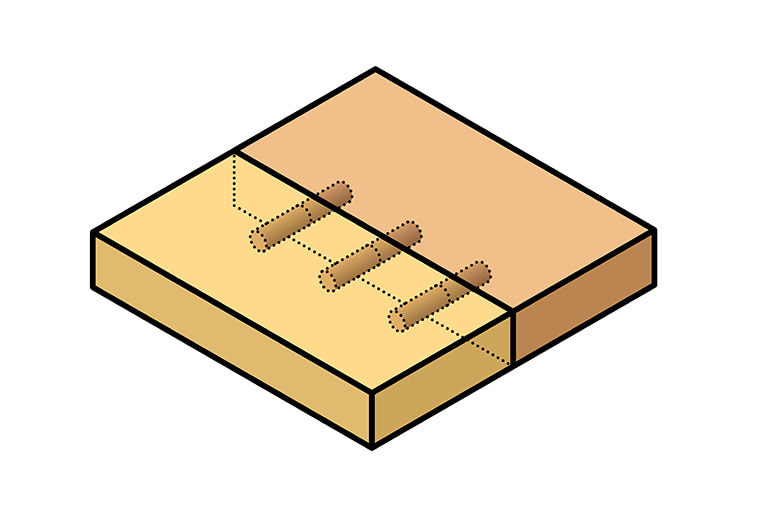
Simply put, a dowel joint is a method of connecting two pieces of wood using cylindrical wooden dowels. These dowels are inserted into precisely drilled holes on both mating parts, creating an accurate and reliable connection. This technique is widely used in furniture manufacturing, kitchen cabinets, and DIY projects thanks to its versatility and its ability to produce joints that are nearly invisible.
Dowel joints are often compared to other joinery methods such as pocket-hole screws or mortise-and-tenon joints. While they may not be as structurally strong as a traditional mortise-and-tenon, dowel joints offer an excellent balance of strength, simplicity, and cost, making them an ideal choice for many applications.
Additionally, dowel joinery is a great solution when you want to maintain a clean aesthetic in your woodworking projects. It creates a seamless, refined joint without the need for visible screws or nails—elements that can disrupt the elegant appearance of the final product. This combination of functionality and aesthetics is why dowel joints continue to be highly favored in modern woodworking.
Pros and Cons of Dowel Joints
Pros
Strong and reliable:
When executed correctly, dowel joints create a very solid connection capable of handling significant loads. This makes them suitable for frequently used furniture such as chairs, tables, and cabinets.
Highly versatile:
Dowel joinery can be applied to almost any woodworking configuration—from edge joints and T-joints to 45° miter joints. It works well for both large furniture and small craft projects.
Excellent aesthetics:
The joint is nearly invisible, giving the final product a clean, seamless look. In some designs, makers even leave the dowels exposed as a decorative feature.
Cost-effective:
Requires no complex or expensive tools. Even beginners can achieve professional-looking results at a low cost.
Ideal for mass production:
Once properly set up, dowel joints are easy to repeat with high consistency. This makes them extremely useful for large-scale production where identical parts must match perfectly.
Cons
Requires high precision:
Misaligned or inaccurately drilled holes can weaken the joint or make assembly difficult. Precision is critical, especially when working with thin stock.
Time-consuming:
Aligning and drilling the holes takes careful setup. Even with jigs, dowel joinery can be slower than some alternative methods.
Limited load capacity:
Although strong, dowel joints are not ideal for heavy structural loads, large frames, or applications demanding extreme durability.
Glue-related issues:
If glue is applied unevenly or the dowels don’t fit tightly, joint strength may deteriorate over time. Dowel joints rely heavily on adhesive quality and accuracy of fit.
Common Adhesive Groups and How to Use Them
Please contact HITTA for guidance on selecting the most suitable adhesive.
Modern woodworkers primarily rely on a few major adhesive categories. PVA glue (white or yellow wood glue) is the most widely used for interior furniture joints. PVA cures as water evaporates and forms a strong bond between wood fibers. Standard PVA is intended for interior use only, but many waterproof variants exist. For example, PVA rated ANSI Type II/III is considered water-resistant and is suitable for humid environments based on industry standards.
In Europe, PVA is classified under EN 204 as D2 (interior, light moisture), D3 (water-resistant, limited outdoor use), and D4 (high water resistance for exterior applications). In practice, high-quality PVA that meets D3/D4 or ANSI Type II/IIIcan withstand rain and moisture when the wood surface is properly sealed or coated.
Two-part epoxy stands out for its exceptional strength and moisture resistance. When the resin and hardener are mixed, epoxy forms a rigid, waterproof bond that repels moisture and can even cure underwater. In many woodworking tests, epoxy demonstrated bond strength exceeding the surrounding wood—meaning failures typically occurred in the wood rather than the glue line. Epoxy is ideal for exterior use, harsh conditions, or bonding dissimilar materials (such as wood to metal), and consistently meets the highest waterproof ratings (ANSI Type I or EN D4).
Its drawbacks include higher cost, the need for precise mixing ratios, longer cure times, and potential skin irritation.
One-component polyurethane glue (PU 1K) also produces a fully waterproof bond. PU expands into foam when exposed to moisture, offering excellent gap-filling capability and strong adhesion to many different materials. However, long-term testing shows that PU may not be as durable as epoxy or some high-grade PVA adhesives for exterior wood joints—especially in mortise-and-tenon joints exposed to the elements for extended periods, where glue-line separation can occur.
Even so, PU remains popular for outdoor structures, decking, pergolas, and mixed-material assembly. It requires safety precautions due to isocyanates and careful control to avoid excessive foam expansion.
Older structural adhesives such as resorcinol or melamine-urea formaldehyde were originally engineered for extreme water resistance, capable of passing boiling-water tests. They were once widely used in boatbuilding and exterior timber construction. Today, due to toxicity and cost, they are far less common; modern water-resistant PVA or epoxy usually fulfills the same requirements with fewer drawbacks.
Finally, fast-setting adhesives like cyanoacrylate (CA) and hot-melt glue are also found in woodshops. CA bonds within seconds, making it convenient for quick repairs, but it is brittle, low-strength, and not moisture-resistant—so it should not be used as the primary adhesive for structural joints. Similarly, hot-melt glue cures rapidly but has low durability and breaks down under heat or moisture, making it suitable only for temporary positioning or non-structural applications.
Choosing Adhesives by Cure Speed
Different adhesives have significantly different open times and clamp times. Fast-curing adhesives allow high-speed assembly or the ability to glue multiple joints with the same set of clamps, while slow-curing adhesives give you more working time and can fill larger gaps.
Fast-Curing Adhesives
— Cyanoacrylate (CA) cures in just a few seconds on wood.
— Some “5-minute” epoxies (1- or 2-part) cure within minutes, although their working time is very short.
— Certain fast-setting PVA formulas or liquid hide glue require only 10–15 minutes of clamping.
Pros: Very quick assembly; useful for complex glue-ups.
Cons: Short working time; sometimes lower ultimate strength compared to slow-curing adhesives.
Slow-Curing Adhesives
— Standard PVA requires 20–30 minutes of clamping and reaches full strength after 24 hours.
— Polyurethane (PU) typically needs 1–2 hours of clamping and cures overnight for maximum strength.
— Slow-set 2-part epoxy (30+ minutes open time) requires 6–24 hours for full cure, making it ideal for large or complex assemblies.
Slow-curing adhesives generally offer better gap-filling—especially epoxy, which achieves optimal strength at thicker glue lines—and allow adjustments during assembly.
Practical Usage
— Use fast adhesives for small repairs, jigs, fixtures, or small components.
— Use slow adhesives for tabletops, multi-panel glue-ups, large mortise-and-tenon joints, or whenever gap-filling is required.
Most manufacturers offer both quick-set and extended-open-time versions, allowing you to choose based on your workflow.
Selecting Adhesives by Water Resistance and Outdoor Durability
Water exposure is a key factor in exterior woodworking projects. Adhesives are classified under ANSI/HPVA and EN 204 standards:
ANSI Type I → Fully waterproof (passes boil–dry cycle testing).
ANSI Type II → High water resistance (passes cold-water soak testing).
EN 204 D2 → Interior use, light moisture.
EN 204 D3 → Water-resistant; suitable for sheltered outdoor use.
EN 204 D4 → Exterior use; continuous water exposure, rain, and weather.
| Furniture Type / Environment | Recommended Adhesive | Technical Notes (ANSI / EN Ratings) |
|---|---|---|
| Dry indoor furniture (bedroom, living room, etc.) | Standard PVA, hide glue | Suitable for dry conditions; no water-resistance required. |
| Moist indoor areas (kitchen, bathroom) | Water-resistant PVA (Type II or D3) | Moderate water resistance; handles humidity and light splashes. |
| Outdoor furniture (patio tables, pergolas, outdoor seating) | High water-resistance PVA (Type I/III or D4), or Epoxy, PU | Withstands rain, prolonged moisture, and temperature changes. |
| General note | Always check ANSI/EN ratings rather than relying on “waterproof” labels | Standardized ratings give a more accurate measure of true water resistance. |
Application by Environment
1) Interior – Dry conditions
- Most PVA D1/D2 or ANSI Type II adhesives are suitable.
- Not recommended for outdoor use.
2) Interior – Humid areas / occasional water exposure
- Use water-resistant PVA (ANSI Type II or EN D3).
- Tests show that Type II PVA maintains very good bond strength under occasional moisture exposure.
3) Exterior – Rain, sunlight, weather exposure
- Use fully waterproof adhesives:
- PVA Type I/III or EN D4
- Epoxy
- Polyurethane (PU)
- Field tests indicate that high-water-resistance PVA (Type III/D4) can perform on par with epoxy in harsh outdoor conditions.
- PU and PVA D4 generally meet outdoor durability requirements by default.
- Phenol–resorcinol remains the only adhesive that provides true “boil-proof” durability, commonly used in boatbuilding and heavy-duty exterior structures.
The Role of Adhesives in Wood Joint Strength
A properly glued joint is significantly stronger and more durable than one relying solely on mechanical fit. Wood adhesives work by penetrating and locking into the wood fibers; once cured, the glue line often exceeds the strength of the wood itself. In practice, many joints fail in the wood rather than at the glue line, showing that the adhesive is not the weak point. For example, in tests on mortise-and-tenon joints using water-resistant PVA, the tenon failed while the glue line remained intact. This demonstrates that with the right adhesive, the load is distributed evenly across the entire joint rather than concentrated on a single peg or screw.
High-quality adhesives also help joints resist environmental stress. A well-sealed glue line limits moisture absorption at end grain and mating surfaces, reducing swelling, shrinkage, warping, and splitting. For load-bearing furniture such as chairs and frames, a glued joint maintains stiffness, transfers force evenly, and prevents loosening over time. Industry guidelines regard proper adhesive selection as essential for structural stability, long-term durability, and reduced maintenance needs. In applications requiring extreme reliability, craftsmen may reinforce joints with dowels or splines, but the adhesive remains the primary bonding force.
Conversely, choosing the wrong adhesive or applying it incorrectly can compromise the entire joint. Most wood glues (except epoxy) require tight, well-fitted surfaces; gaps or contaminated/oily surfaces substantially weaken the bond. This is why joint fit and clamping pressure are critical factors. Epoxy is the exception, as it maintains strong bonds even with minor gaps. In short: wood glue doesn’t just “stick” two pieces together — it turns them into a unified structure, greatly increasing strength, stability, and safety, as long as the correct adhesive and proper technique are used.
Contact Information
Hitta is a trusted provider of advanced adhesive and tape assembly solutions from leading global brands.
With a highly experienced technical team across multiple industries, we not only supply products but also deliver tailored bonding solutions that optimize your existing processes and address your specific application challenges.
If you are looking for a high-performance, durable, and reliable adhesive solution, let HITTA be your partner — from consultation to implementation.
- ☎️ Hotline: 0565.336.879
- ✉️ Email: hittajsc@hitta.vn